
A miner’s heat becomes valuable when someone needs it. A hot-water tank offers a practical destination, but the household’s existing heating system determines the value. Bitwater is an interesting example of this engineering idea, not yet evidence of a proven household investment.
What was announced on 23 October
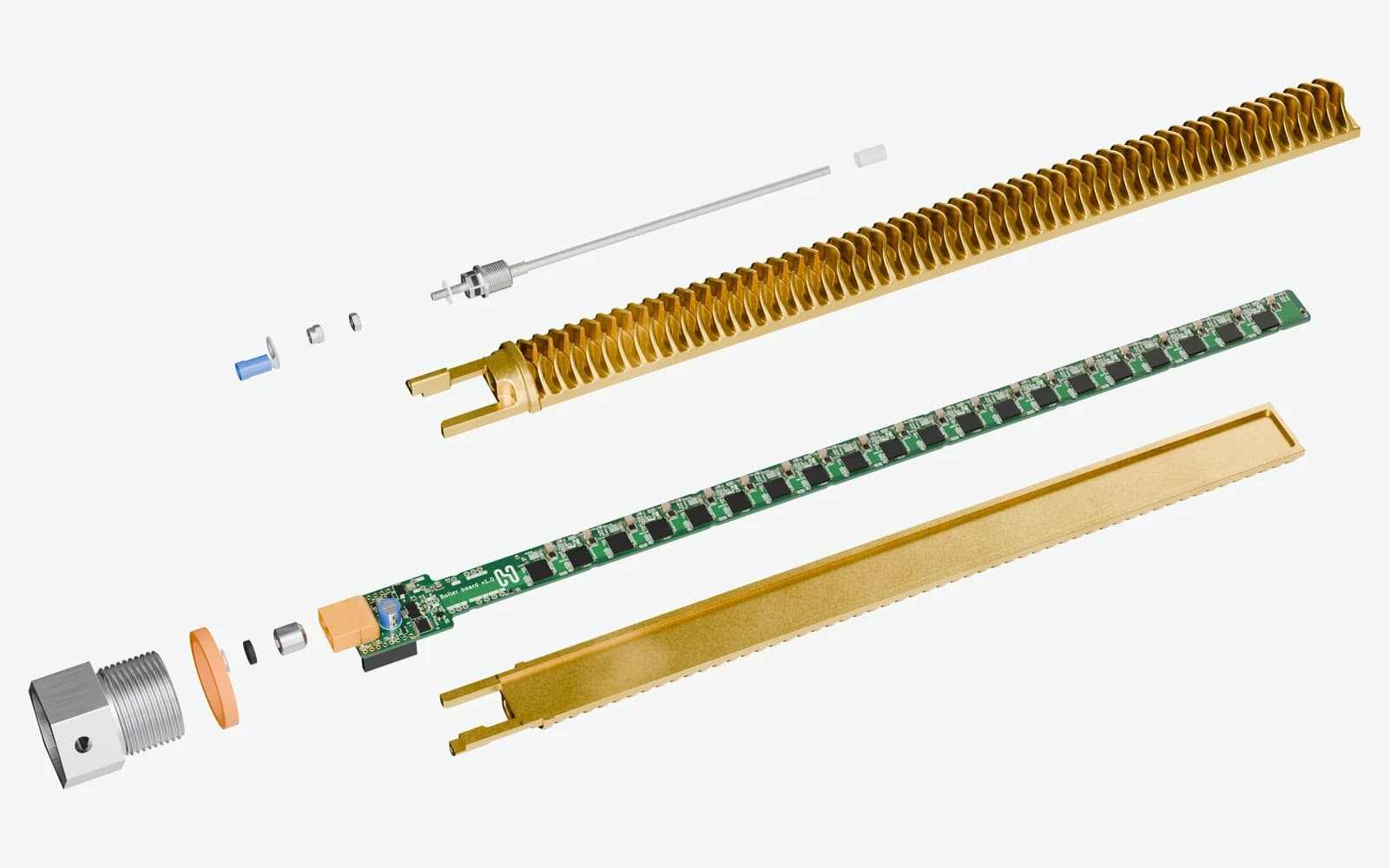
Decrypt reported on Heatbit’s Bitwater on 23 October 2026. The company is offering a first-batch preorder at $899, with shipments planned for the first quarter of 2027. The announced offer targets the United States and Canada. This is a heating element for an electric storage water heater, rather than a complete new tank.
Heatbit lists up to 34 TH/s of Bitcoin hashrate and up to 600 W of power consumption. These are manufacturer claims. Two advertised maxima do not establish one measured operating point: we cannot derive a verified mining efficiency or daily revenue by assuming both occur together.

Heat must replace a real expense
The useful comparison is the same amount of hot water at the same temperature, with and without the miner. Count only heat that displaces another heat source. Extra tank losses, unwanted warmth and operation after demand has been satisfied do not automatically become savings.
A resistance heater is the simplest baseline. A heat pump changes the comparison because it moves heat and can deliver several units of heat per unit of electricity. With an illustrative COP of 3, replacing 14.4 kWh of useful heat avoids 4.8 kWh of electricity, not 14.4. This example is not a measured Bitwater result or a guaranteed heat-pump performance.
The electricity calculation: €1.08 a day
Calculation dated 24 October 2026: 0.6 kW × 24 hours = 14.4 kWh; 14.4 × €0.075/kWh = €1.08 per day, or €32.40 over 30 days. This assumes uninterrupted operation at 600 W. It excludes mining income and any credit for useful heat.
The reference tariff is a calculation input, not a claim about regional household prices. At €0.15/kWh the same operation costs €2.16 daily; at €0.25/kWh it costs €3.60. A shorter operating period reduces both electricity use and the opportunity to mine.
Scandinavia: cold weather is only part of the story
Norway, Sweden and Denmark do not form one electricity or heating market. Finland is also relevant to this Nordic comparison. A house with an electric hot-water tank presents a different starting point from an apartment connected to district heating or a house using a heat pump.
Space-heating demand falls in summer, while showers and kitchen use continue. That makes domestic hot water a potentially steadier heat destination, but not an unlimited one. Occupancy, tank size, incoming water temperature and thermostat control determine how long useful heating can continue. A holiday home with no occupants is a poor basis for assuming year-round full utilisation.
The Baltics: start with the building’s system
In Estonia, Latvia and Lithuania, district heating is an important part of the housing context. In a building with centrally prepared hot water, there may be no individual electric tank to retrofit. A separate installation would need its own technical and economic justification; it cannot simply be counted as a replacement for the household’s existing hot-water bill.
For an individual house, compare the actual alternative: electric resistance, a heat pump or another boiler. Nord Pool prices also differ between bidding areas. The relevant electricity input is the marginal cost on the customer’s contract, including applicable network charges, supplier fees and taxes, not an isolated wholesale price.
North American compatibility is not European approval
The announced US and Canadian market fit does not establish compatibility with a European tank. The element mounting, electrical supply, controls, pressure rating, drinking-water requirements and manufacturer warranty all need confirmation for the exact installation. A voltage range alone cannot answer these questions.
Hot-water availability and temperature protection must remain the priority. Cheap electricity periods can be useful for scheduling, but a tank has finite storage capacity. Deliberately overheating water to keep mining would undermine the heat-reuse argument.
What would make the case convincing
As of 24 October, the sources reviewed do not confirm independent testing of a serial-production unit or completed customer deliveries. The next useful evidence would be simultaneous wall-power and hashrate measurements, useful heat delivered to water, operating hours and the behaviour of backup heating.
A credible comparison would also record hot-water consumption before and after installation. Purchase cost, installation, maintenance and mining fees belong in the final economics. Manufacturer product images shown here illustrate the design; they are not photographs of an independently verified customer installation.
A useful engineering question, still awaiting measurements
Bitwater makes ASIC heat reuse easier to discuss at household scale. For Nordic and Baltic homes, the deciding factors are demand for hot water, the displaced heating technology and the actual electricity contract. Those inputs should come before a mining-income estimate or a payback claim.
Sources and further reading
Sources support the planning method; project-specific engineering and local compliance review are still required.