

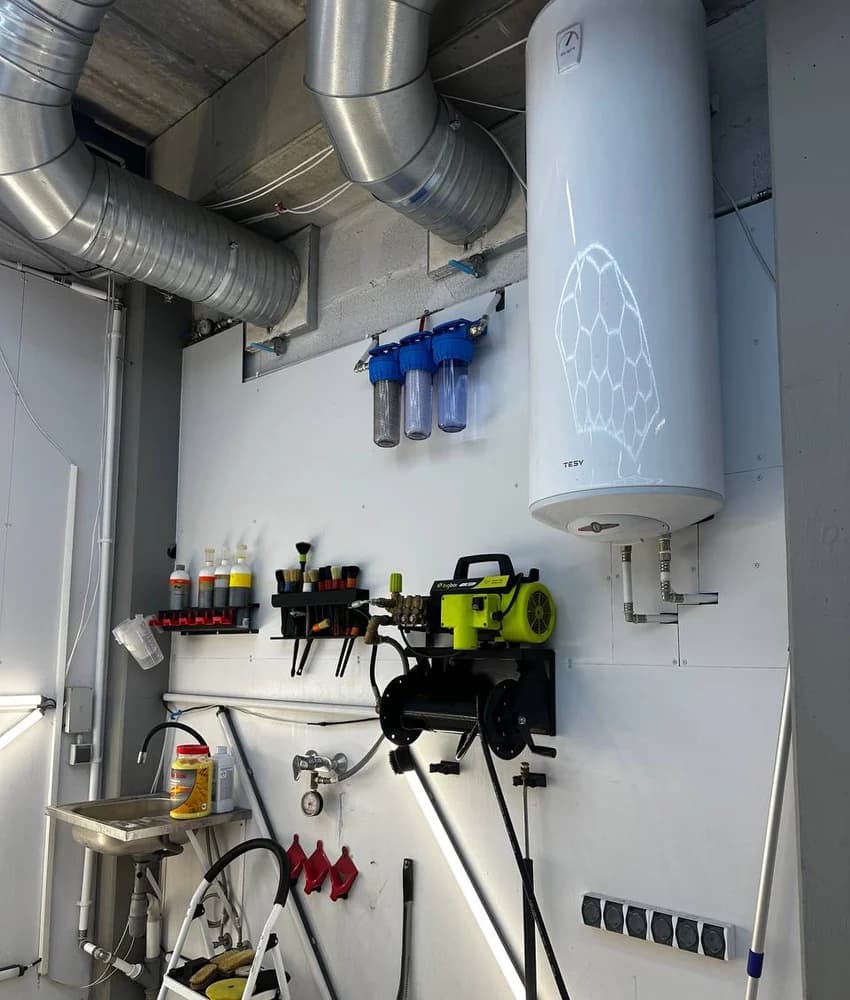
The useful question for a wash owner is how many litres of water the business buys heat for when the bays are busy. At S3D we use the detailing bay and its existing water heater to explain the calculation. The film illustrates a proposed arrangement. The figures below are engineering estimates under stated conditions. There is no recorded tank test or energy bill in this case from which to establish actual savings.
Where the heat goes
A miner draws electrical power while it computes. In this example a cooling circuit carries heat to one side of an exchanger. Water on the other side absorbs heat before entering the existing heater. The two fluids stay separate. The heater can finish the job when the inlet is cold, several bays open together or the miner stops. Before choosing equipment, check what coolant temperature the specific machine permits and whether the exchanger can deliver useful heat at that temperature.
What one hour buys
Assume a steady electrical input of 3 kW and that 93% reaches the water. That gives 2.79 kWh of useful heat in one hour. Raising one litre by one degree takes about 1.163 Wh. Divide 2,790 by 200 and then by 1.163. A well-mixed 200-litre tank starting at 10 °C would reach about 22 °C with no draw or additional heater. A thermometer at the top can read warmer than the average across the tank.
For a different job, divide the same energy by the temperature rise from 10 to 50 °C. The result is about 60 litres per hour. These are two uses of the same energy budget. At a demand of 300 litres per hour one machine covers about one fifth. Five machines would match that hour on paper and draw 15 kW together before pumps. Storage charged before the rush can change how many machines are worth running.
Which sites fit
A staffed wash that cleans vehicles throughout the day can absorb a steady trickle of heat. A detailing studio can also be a candidate if staff regularly use warm water for cleaning and there is room for a buffer. A self-service site should separate hot programmes from cold rinses in its figures. A fleet depot that washes everything at the end of a shift may benefit from storage, provided the tank has time to recharge and the next shift actually uses the heat.
A mostly cold-water wash, a seasonal bay or a site already buying inexpensive heat has a weaker starting point. Check spare electrical capacity while dryers and pumps are running. Allow for drainage, access for servicing, noise and protection from spray. Decide what the cooling system will do overnight when the tank is full and the wash is closed.
How to check your own numbers
Read the hot-water meter before and after the busiest hour on several ordinary days. Record inlet and delivery temperatures, opening hours, tank size and heater fuel. If the meter is upstream of a mixing valve, note the measuring point so the volume and temperature refer to the same water. Compare the value of displaced heat with electricity, pumping, maintenance and installation costs. Keep mining income separate so the operator can see what happens when it falls.
For a pilot, record the initial and final tank temperatures, the volume, elapsed time and electricity at the meter. Note whether any water was drawn and whether the backup heater ran. Repeat the test at the actual working temperature, where the exchanger has a smaller temperature difference to work with.
Request a site estimate
Send ForMiners your peak litres per hour, both temperatures and a photo of the existing heater. Include the heat source and the electrical capacity available during the rush. We can use those figures to compare one miner for preheating with a larger installation or a larger tank before proposing equipment.
Sources and further reading
Sources support the planning method; project-specific engineering and local compliance review are still required.