
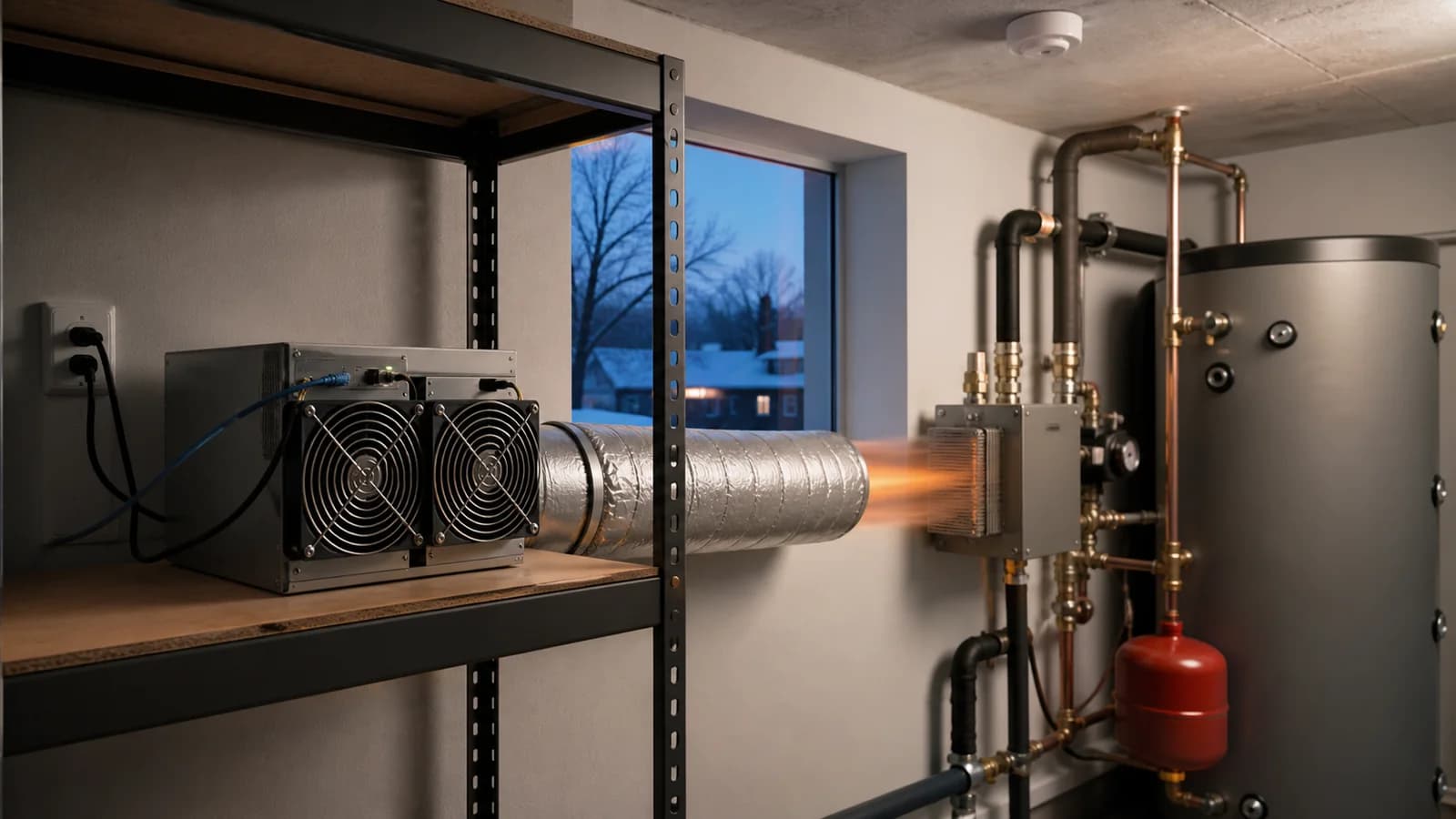
Home mining no longer means placing a full-size industrial ASIC beside a sofa. Compact Bitcoin devices, purpose-built mining heaters and quieter Scrypt machines have created a real home-use category. They can teach the operator how pools, wallets and hardware work, accumulate cryptocurrency directly and provide useful heat during the cold season. The important question is not whether a box is advertised as “home”, but whether its algorithm, wall power, sound profile, electrical connection, ventilation and economics fit one particular building. This guide adapts Oleg Angelsky's original article with current manufacturer data and a practical selection method for 2026.
“Home miner” describes a use case, not a safety certificate
The smallest class includes open or enclosed desktop miners such as Bitaxe-type Bitcoin devices. Their low power makes them useful for learning, solo-mining experiments and modest background heat, but they are not comparable with an industrial ASIC in hashrate. The next class contains purpose-built home units, commonly drawing several hundred watts to around one kilowatt and designed around quieter fans, larger heat exchangers or heater-style controls. Above that are compact but still substantial machines around 1–2 kW. A conventional 3–4 kW air-cooled ASIC remains industrial equipment even if it physically fits in a garage.
Marketing labels do not replace a technical review. Check the exact model and batch, supported algorithm, nominal and maximum wall power, input voltage, plug and cable, networking, operating-temperature range, firmware source, warranty and service route. Sound figures should be treated as manufacturer test results, not a promise for every room: tonal fan noise, vibration, distance and reflective walls strongly affect what a person hears.
- Desktop and micro devices: easiest entry, limited hashrate and heat
- Purpose-built home ASICs: hundreds of watts, enclosure and comfort features
- Compact high-output units: more heat and revenue potential, stricter placement
- Industrial ASICs: dedicated electrical and ventilation design required

Two verified examples show why the algorithm comes first
Canaan's Avalon Mini 3 is a SHA-256 Bitcoin miner designed as a heater. The manufacturer lists 37.5 TH/s, up to 800 W, 110–240 V input and a rated noise range of 33–55 dB. Its heater controls include 500 W Eco and 800 W Super settings, while mining and night modes change the balance between temperature, hashrate and fan behavior. Those figures make it a useful example of an integrated mining heater, not a universal answer for every tariff or room.
ElphaPex's DG Home 1 targets Scrypt. Its manual specifies 2,100 MH/s ±3% at 630 W ±10%, with a 2,300 MH/s high-performance mode at 700 W, 100–240 V input, Ethernet and Wi-Fi, and an integrated liquid radiator inside the chassis. The same manual does not publish a numeric room-noise figure, so acoustic suitability should be confirmed for the actual batch and placement. SHA-256 and Scrypt devices do not mine the same assets; model selection begins with the intended algorithm and pool, not cabinet appearance.
- Avalon Mini 3: SHA-256, Bitcoin, heater-oriented controls
- DG Home 1: Scrypt, commonly used for merged Litecoin/Dogecoin mining
- Confirm current batch, firmware, included cable and regional plug before ordering
- Never compare profitability using hashrate numbers from different algorithms
Plan for 24/7 sound, power and airflow before buying
A sound level that seems acceptable in a short video can become tiring when the fan tone runs continuously. Avoid bedrooms and shared quiet rooms by default. A utility room, ventilated workshop or separated office corner is usually easier to manage. Use a stable non-combustible surface, vibration-isolation feet and the clearances required by the manufacturer. Never wrap an ASIC in soft soundproofing that blocks cooling air. If an acoustic enclosure is considered, its intake, exhaust, filters and temperature shutdown must be engineered as one system.
Wall power is a continuous load, not an occasional kettle load. A qualified electrician should verify the circuit, protective device, earthing, socket, cable temperature and the other loads sharing that circuit. Do not rely on a multi-plug extension. Keep hot exhaust away from curtains, furniture, children and pets; install appropriate smoke detection and maintain access for shutdown. Network stability also matters: configure a known pool, backup pool, secure password, supported firmware and monitoring alerts before leaving the machine unattended.
- Measure sound at the intended listening position, not only beside the machine
- Verify circuit capacity and earthing for continuous operation
- Provide unobstructed intake and a deliberate exhaust route
- Set temperature, hashrate and offline alerts
Watts become heat, but square metres are the wrong shortcut
Almost all electrical input to computing equipment ultimately appears as heat at the site. In simple planning terms, an 800 W miner is roughly an 800 W heat source before distribution losses. That does not prove it can heat a stated floor area: the building's heat loss depends on insulation, leakage, outdoor temperature, ceiling height and ventilation. Compare miner output with a room-by-room heat-loss calculation or measured heater duty, not a universal “metres squared” claim.
The heat is most valuable when it replaces electric resistance heating during hours the building actually needs warmth. It is not equivalent to a heat pump, which can move more heat per unit of electricity. Air-cooled units can warm a room or feed a correctly designed duct. Liquid or immersion systems can transfer heat into a water loop, but require pumps, a heat exchanger, controls, leak protection and an independent backup heat source. In summer, every watt still becomes heat, so the project needs an outside exhaust or another useful heat sink.
- 1 kW of miner input is approximately 1 kW of site heat before losses
- Size against heat loss, not floor area alone
- Credit heat only when it displaces a paid source
- Design summer heat rejection before winter commissioning
Calculate a range, not a promised payback date
Mining income changes with asset prices, network difficulty, block economics, pool method and uptime. Electricity cost, pool fees, service, downtime and hardware depreciation must be included. A useful home model separates cold-season and warm-season operation. During useful-heating hours, the avoided cost of the displaced heater may be counted; during summer, ventilation or cooling can add cost. Taxes and local rules remain the owner's responsibility.
A transparent calculation is: mining revenue minus electricity, pool fees, service and downtime, plus only the verified value of useful heat. Run low, base and high scenarios and update them before purchase, because an old screenshot is not a quotation. Home mining can still make sense as a learning tool, a direct accumulation method or a combined heater, even when pure financial payback is uncertain. It should not be sold as guaranteed passive income.
- Use current network and pool data on the day of the quote
- Model winter and summer separately
- Include hardware, electrical work, ventilation and service
- Treat revenue, uptime and resale value as uncertain
Who benefits from a home ASIC—and who should pause
A compact miner suits an owner who understands the chosen coin, has a safe placement, accepts continuous sound and wants hands-on experience. It can also fit a workshop, garage, small office or technical room with a genuine heating demand. It is a poor choice for someone expecting silence in a bedroom, relying on one shared household circuit, lacking a summer exhaust route or needing a fixed monthly return. Rental agreements, insurance and building rules should be checked before installation.
The best first step is a short site checklist: country and voltage, electricity tariff, available circuit, intended room, acceptable sound, internet connection, preferred algorithm and whether the heat has a real use. These inputs narrow the equipment class much more reliably than asking which miner is “most profitable” in general.
- Good fit: learning, direct accumulation and useful winter heat
- Possible fit: workshop, garage, office or separated utility space
- Poor fit: silent living space or overloaded shared circuit
- Stop and redesign if summer heat has nowhere to go
ForMiners can source the machine and help design the setup
ForMiners supplies compact and home-class mining equipment on request. Exact model, algorithm, region and voltage, firmware, condition, warranty, lead time and current availability are confirmed in the quotation. Because the public catalogue changes faster than a technical article, we do not promise that every example named here is in stock. We can shortlist a current Bitcoin or Scrypt option from the customer's tariff, room, heat demand and sound limit.
Our scope can also include electrical-load review, placement and acoustic concept, ventilation or heat-reuse design, network and pool onboarding, monitoring, commissioning and service. For larger heat-reuse projects we can compare air, hydronic and immersion approaches. Send the site location, electricity price, available amperage, room photos and intended heat use through the contact form; we will identify missing measurements and return with a practical equipment route.
- Equipment selection and sourcing under a current quotation
- Electrical, acoustic and thermal placement review
- Pool, network, monitoring and commissioning support
- Air, hydronic or immersion heat-reuse options
Start with the room and the energy plan, then choose the ASIC
A home miner can be a useful combination of computing, direct crypto accumulation and winter heat. The successful installation is not defined by the smallest box or the biggest daily-income screenshot. It is defined by a compatible algorithm, safe continuous power, tolerable sound, controlled airflow and economics that remain understandable under weaker scenarios. ForMiners can help verify those constraints and source suitable equipment under a current, model-specific quotation.
Sources and further reading
Sources support the planning method; project-specific engineering and local compliance review are still required.
- Oleg Angelsky — original Teletype article, 19 November 2025
- Canaan official shop — Avalon Mini 3 specifications
- Canaan Support — explanation of Avalon Mini 3 operating modes
- ElphaPex — official manufacturer website
- ElphaPex DG Home 1 Server Manual, version 1.0.0
- U.S. Department of Energy — Industrial Electrification booklet