

Quantus combines proof of work with post-quantum signatures. Its first weeks show both opportunity and a warning: a rising coin price can attract computing power faster than it improves a miner’s revenue.
At a glance
QTC is the native coin; QPoW is the consensus engine; Poseidon2 is the mining hash function. GPU mining is practical, CPU mining is possible, and Bitcoin or Scrypt ASICs cannot be repurposed for this workload. The verified exchange market is SafeTrade QUANTUS/USDT.
Dated snapshot, not a live quotation. Price: 04 Oct 2026, 14:17 UTC; network: 14:18 UTC.
Illustration generated with AI; not a photograph of a Quantus facility or a tested rig.
What Quantus actually is
Quantus mainnet started on 9 September 2026. The project positions it as private, post-quantum digital money rather than a general-purpose smart-contract platform. Its native ticker is QTC; it is unrelated to Quai, Qubic and Qitchain. A quantum computer is not required to mine it.
The distinction matters: QPoW searches for a valid Poseidon2 hash, while ML-DSA-87 protects signatures. Poseidon2 was selected for compatibility with zero-knowledge circuits; the mining algorithm itself is not a lattice-solving task. Post-quantum design is a technical direction, not a guarantee against software bugs, exchange failure or losses.
Maximum supply is 21 million QTC. The documentation describes a 27% genesis allocation subject to vesting and roughly 73% for later mining issuance. Rewards decay with remaining unissued supply rather than following Bitcoin-style halvings. A capped supply therefore does not mean that every coin was distributed through mining.
Where QTC trades — and the ticker trap
The CoinGecko snapshot identifies one tracked spot market: SafeTrade, base asset QUANTUS, quote asset USDT. SafeTrade’s separate QTC/USDT market is another asset, Qubitcoin. Always check the project name, network, deposit instructions and full trading-pair URL; matching three letters is insufficient.
The captured ticker reports approximately US$577,123 in 24-hour converted volume and a 2.03% bid–ask spread. These are time-specific aggregator observations, not a liquidity guarantee. Reported volume does not tell you how much can be sold near the displayed price. Before evaluating a position, inspect the live order book, deposit/withdrawal status, limits and trading costs.
The official site still labels the NEAR Intents purchase route as coming soon in the material reviewed. An announced integration is not an additional confirmed live exchange. No other market was independently verified in this research. CoinGecko returns unavailable/zero circulating-supply data; this must not be interpreted as a real zero market capitalization.
The rally and the correction: read both
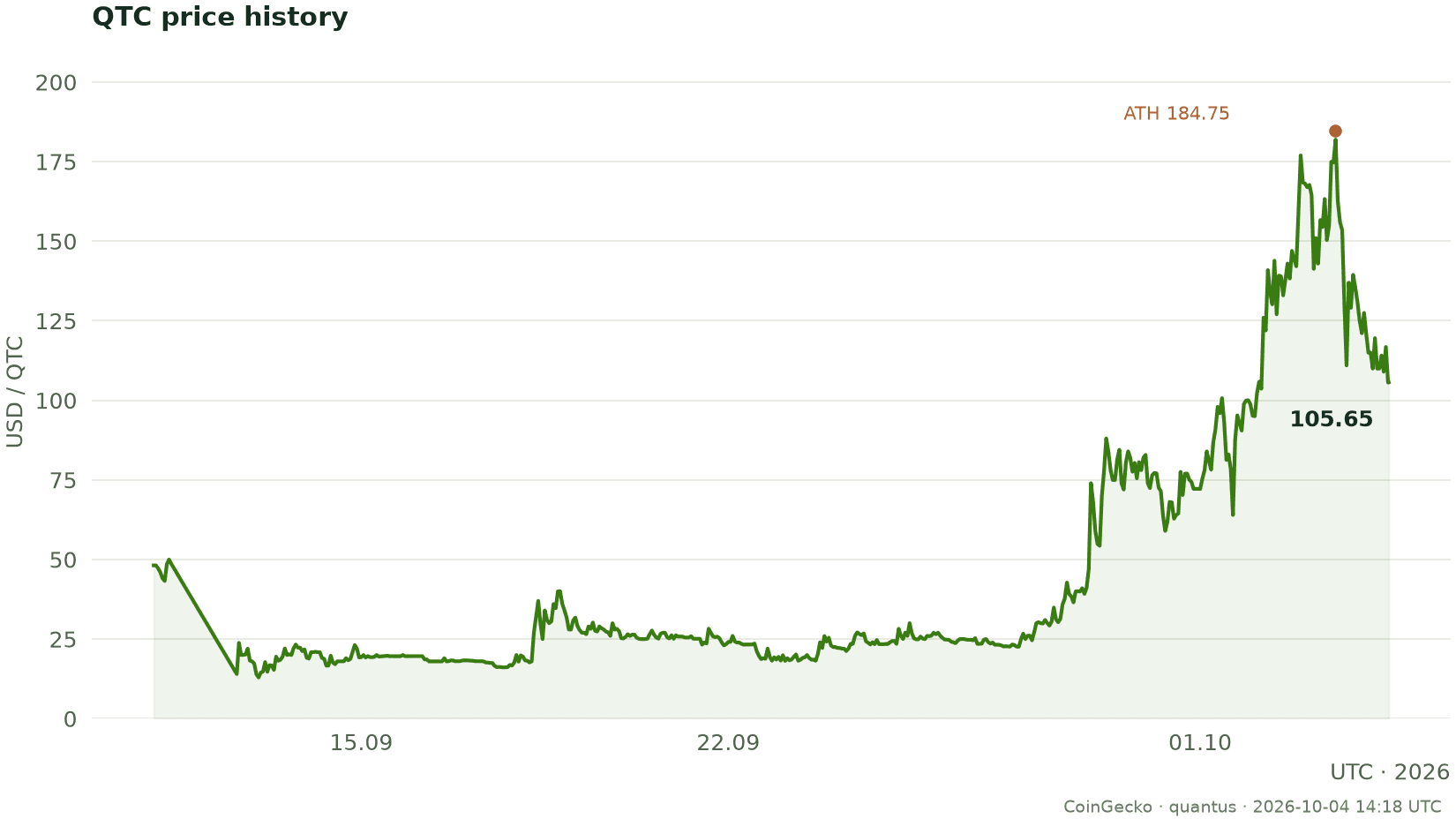
At 14:17 UTC on 4 October 2026, CoinGecko’s snapshot was US$105.65, up 322.87% over seven days but down 39.55% over 24 hours. The recorded all-time high was US$184.75 on 3 October; the snapshot was 42.81% below it. The reported low was US$10.20 on 12 September. These moves describe a very young and volatile market, not an established return pattern.
The downloaded series begins on 11 September at about US$48.15 and ends on 4 October at US$105.65: approximately +119.41% between those sampled endpoints. That is different from measuring from the all-time low or from a seven-day baseline. Choosing the lowest starting point can greatly exaggerate how typical an investor’s experience would have been.
The chart contains 538 timestamped CoinGecko observations, predominantly hourly. It is a USD reference-price line, not a SafeTrade candlestick chart or an executable quote. Intrahour extremes can fall between samples. The article preserves a dated snapshot; use the linked market for subsequent prices.
What hardware can mine Quantus?
The official external miner supports CPU, GPU and mixed operation. Its GPU paths include wgpu with Metal on macOS and Vulkan/DirectX on compatible systems, plus native CUDA for NVIDIA. Pool software may support a different set of cards, drivers and operating systems. An algorithm name alone does not guarantee that a particular binary will use your device.
For an initial test, use an existing supported GPU before buying equipment. Pool operators list cards including RTX 3090, 4090 and 5090; their advertised comparisons are not ForMiners laboratory benchmarks. AMD and Apple GPU support depends on the miner and backend. Measure accepted hashrate, power at the wall, temperature, rejected shares and uptime with the exact software version.
A Bitcoin SHA-256 ASIC or Litecoin/Dogecoin Scrypt ASIC has a different fixed-function datapath. A firmware setting cannot turn it into a Poseidon2 miner. No independently verified commercial Quantus-specific ASIC was established in this review. That is not a claim that specialized hardware will never appear, nor a guarantee of permanent GPU profitability.
Solo, pool or rented GPUs
Solo mining means operating a synchronized node and compatible external miner. You receive rewards for blocks you actually find, so a small share of network power can produce long periods with no payout. Expected output is a statistical average; it is not a daily payment schedule.
A pool distributes the work and payouts according to its rules. Kryptex publicly lists Quantus PROP and SOLO modes, a 3% pool fee and a 0.1 QTC minimum payout at the time checked. Quantusminer and quanpool also publish mining interfaces. Their software, custody arrangements, fees and reliability require separate assessment. Pool participation reduces payout variance in shared modes, not the underlying network difficulty.
Rented GPUs avoid a hardware purchase but introduce a fixed rental bill. Compare the effective rental rate, accepted work, pool/miner fees and possible coin-sale slippage over the same interval. A brief price spike or benchmark burst can make a rental calculator look profitable while realized cash flow is negative.
A practical setup checklist
Create a Quantus wallet through official project links and back up its recovery phrase offline. Mainnet and the old Planck testnet are different chains; do not reuse a testnet database as a mainnet node. For solo operation, follow the current mainnet guide, use matching node/miner releases and wait until synchronization completes.
Mining rewards use the protocol’s wormhole address mechanism. For solo mining, the node needs the appropriate inner hash, not a recovery phrase uploaded to a pool. Keep the miner connection local or on a trusted private network and follow the current authentication/TLS instructions. Do not expose the node’s mining service to the internet simply to make a remote GPU connect.
For pool mining, use the pool’s current configuration generator and a compatible release from the miner’s official distribution. Check the payout address, accepted shares and pool-side balance with a small test. Then record 24-hour accepted output and electricity consumption. Peak hashrate alone is not a procurement specification.
Why difficulty can outrun the price
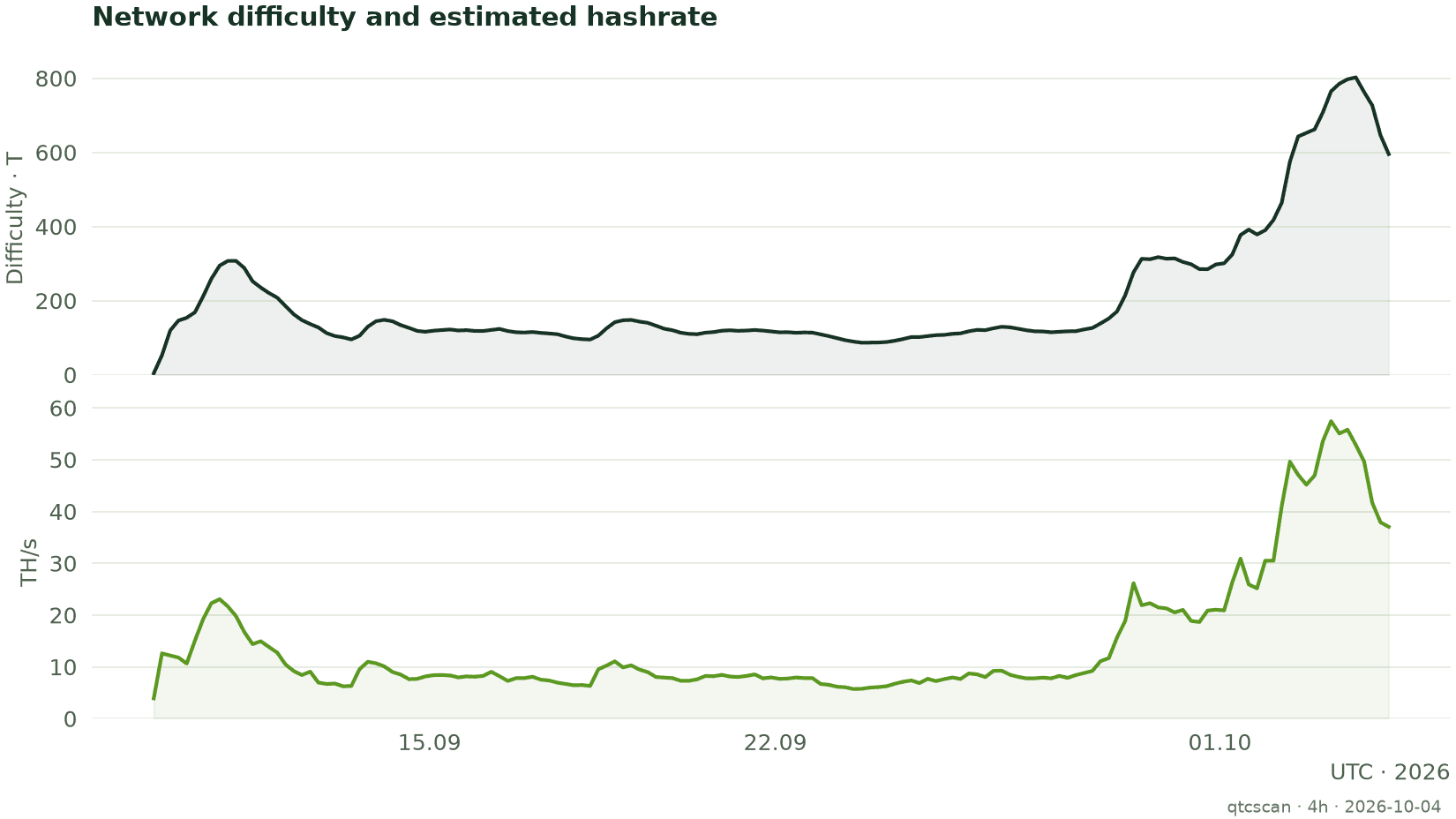
Difficulty is the amount of expected hash work required to find a block. It is not a pool’s share difficulty and is not directly comparable with the difficulty number on Bitcoin or another algorithm. In the 4 October network snapshot, block difficulty was 581.87 trillion, estimated hashrate was 42.91 TH/s over one hour and 44.43 TH/s over 24 hours. The observed 24-hour block interval was 15.81 seconds, versus a 12-second protocol target.
The reviewed implementation retargets after each block. With the current 10-second buckets, a block below 10 seconds raises difficulty by approximately 1/2048, or 0.0488%; 10–20 seconds leaves it unchanged; 20–30 seconds lowers it by approximately 1/2048. Longer intervals allow larger decreases, capped at 99/2048. Integer rounding and minimum/maximum bounds also apply. This is not Bitcoin’s 2,016-block adjustment schedule.
A small percentage per block compounds. Under the artificial condition that every block qualifies for the maximum increase, roughly 1,420 blocks would double difficulty. This is a mathematical illustration, not a time forecast. More GPUs, more efficient software and rented hashrate can all increase competition; miners leaving can push the adjustment the other way.
The project reported a 3,100-fold increase in the first 40 hours after launch. Separately, our calculation from qtcscan’s complete four-hour buckets shows average difficulty rising from 116.80T on 27 September, 08:00–12:00 UTC, to 595.29T on 4 October in the same window: +409.67%, or 5.10 times. This comparison uses matched historical buckets, not the latest single-block value. The chart excludes the final unfinished bucket.
How to evaluate mining economics
A useful first approximation is expected QTC/day ≈ personal hashrate × 86,400 ÷ network difficulty × effective block reward. Use hashes per second and raw difficulty in compatible units. Adjust for rejected work, uptime, pool fees and miner developer fees. Realized revenue then depends on the sale price; electricity, rental, hosting, maintenance and hardware depreciation still have to be subtracted.
For illustration only, assume 1 GH/s, difficulty 581.87T and a constant 0.30 QTC effective reward. Expected production is about 0.0445 QTC/day, or US$4.71 at the captured price, before costs. A hypothetical 300 W system consumes 7.2 kWh/day: at US$0.10/kWh that costs US$0.72. These are chosen scenario inputs, not a measured GPU configuration or a promised profit.
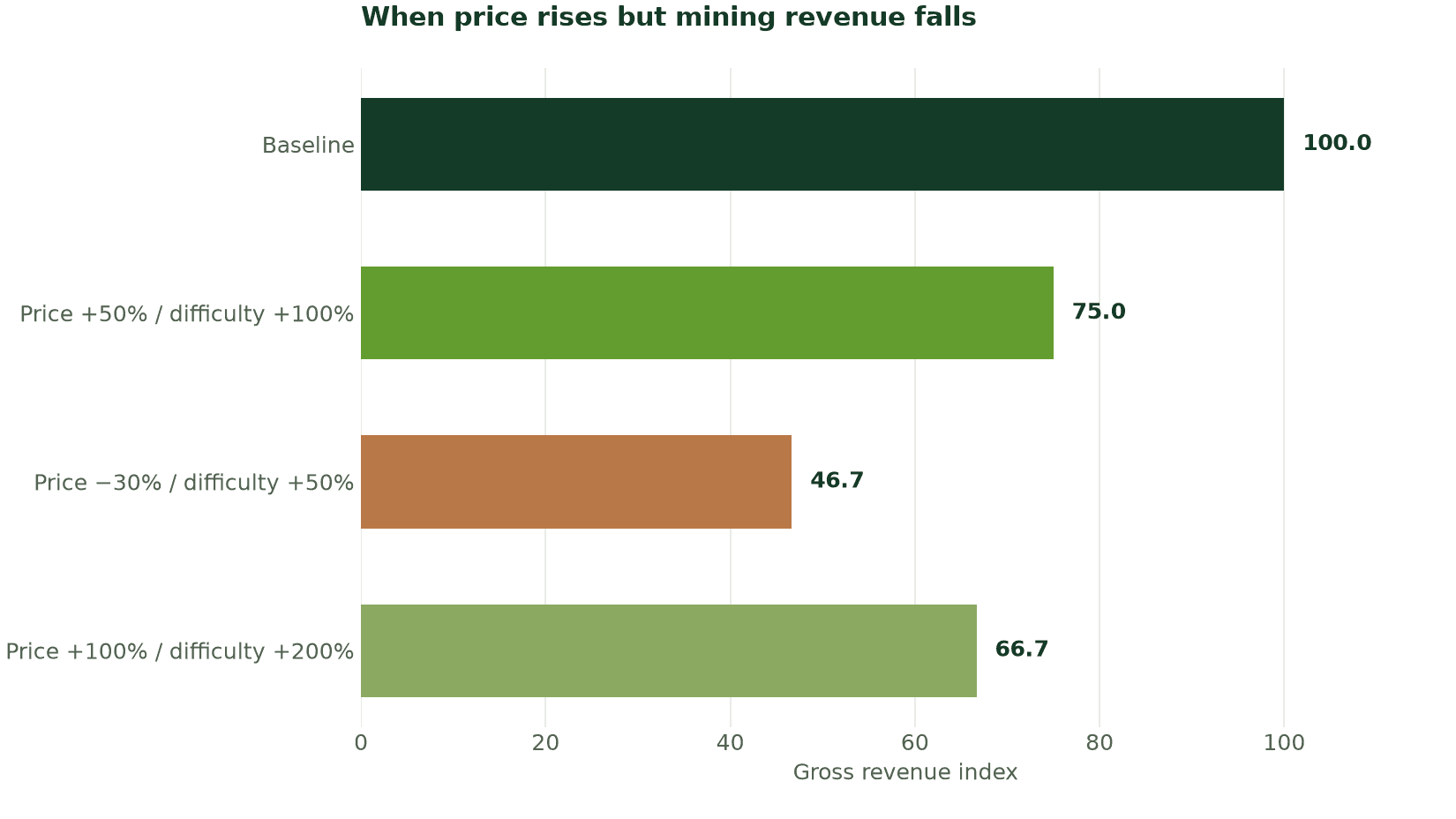
If hashrate and reward stay constant, gross revenue changes approximately in proportion to price divided by difficulty. A 50% price increase combined with a doubling of difficulty reduces gross revenue by 25%. A 30% price fall with a 50% difficulty increase reduces it by about 53%. Solo results also have substantial luck variance; rising difficulty is not evidence that the price must rise.
Prospects: what would strengthen or weaken the case?
The positive thesis is a useful post-quantum payment network with accessible GPU participation, working privacy tools and growing real usage. Evidence that would strengthen it includes independently inspectable security reports, reliable wallets, completed integrations, sustained economic activity and broader executable liquidity. A larger mining hashrate can raise the cost of attacking the chain, but it is also a cost to existing miners.
The main risks are a short operating history, concentrated trading access, substantial volatility, competing miners and future genesis-allocation releases. The official audit page marks some components completed while report links are still pending, and lists other scopes as in progress. That does not justify calling the entire stack fully audited. A secure signature primitive also does not remove implementation, governance, bridge or custody risks.
Our assessment: Quantus is worth technically monitoring and testing on already available hardware. Buying a dedicated fleet or renting large capacity based only on the recent rally would require much stronger evidence. Evaluate three separate questions: does the network deliver useful functionality, can the coin be traded with adequate liquidity, and can your specific rig produce positive cash flow under lower prices and higher difficulty? This is research, not a target-price forecast or an investment recommendation.
Is Quantus a mining algorithm?
Quantus is the network. QPoW is its proof-of-work engine and Poseidon2 is the mining hash function.
Can an Antminer L9 or S21 mine QTC?
Not directly: those ASICs implement Scrypt or SHA-256, not Quantus Poseidon2.
Does higher difficulty make the coin more valuable?
No. It changes expected mining output for a fixed hashrate; market demand and liquidity determine price.
Is the price chart live?
It is a sourced snapshot from 4 October 2026. The timestamp is displayed, CSV data is downloadable, and links lead to the current market.
Sources and data
Market data was captured through CoinGecko; direct automated SafeTrade API reads were rejected. Order-book execution and deposits/withdrawals were not tested. qtcscan is an independent explorer, not the project operator. Its historical response reported complete indexed coverage. Pool terms are operator statements, and no mining benchmark was run by ForMiners. Protocol descriptions refer to documentation and source inspected on 4 October 2026; a later runtime upgrade can change them.
Dated snapshot, not a live quotation. Price: 04 Oct 2026, 14:17 UTC; network: 14:18 UTC.
Before you start
Start with a small measured test. Record accepted work and full costs, verify the correct exchange asset, and update your model whenever difficulty, software or market conditions change.
Sources and further reading
Sources support the planning method; project-specific engineering and local compliance review are still required.
- Quantus · Mainnet launch report · 16.09.2026
- Quantus Docs · QPoW
- Quantus · mining-rewards · source
- CoinGecko · Quantus (QTC)
- SafeTrade · QUANTUS/USDT
- Quantus · official website
- CoinGecko · quantus · market_chart · USD
- Quantus · official external miner
- Kryptex · Quantus pool
- quanpool · operator website
- Quantus Docs · mainnet mining guide
- Quantusminer · operator website
- Quantus · QPoW difficulty · source
- qtcscan · independent explorer
- qtcscan · historical network data
- Quantus Docs · audits and status